Sunday, 30 October 2011

Seeing Poverty

I guess it's not that long since I wrote a fairly lengthy post about life at traffic lights in Managua and I suppose it is one of the differences I have noticed in Manila. Metro Manila alone has a population about three times as large as that of the whole of Nicaragua. There is a lot of wealth and there is a lot of poverty in the Philippines, with a much bigger population the wealth feels more visible than in Managua, even though it definitely existed there too.

The slow traffic means Manila's street vendors don't have to limit themselves to traffic light junctions like in Managua and yet I would say I have seen far fewer vendors or beggars. About a week ago a child came up to the car windows to ask for money and our driver told him to go away. He told us you shouldn't give to children, I asked why and he said they will use money for drugs or glue, he went on to explain that he might offer them food if he has but mostly they reject it or he may give to the blind or disabled or the old.

On the way home on Friday night I watched a blind man being led from car to car by an emaciated female guide and what struck me was how absolutely no-one in any of the vehicles gave them anything, if I had seen the same scenario in Managua I know without a doubt someone would have given a coin or two. I gave nothing either although as we drove away I wished I had.

On the same day on the front page of the newspaper The Philippine Star it read:
The number of Filipino families that experienced hunger grew from about 3 million households in June to about 4.3 million in September, according to a survey released yesterday by the Social Weather Station (SWS). The SWS poll...found that one in five families or 21.5% experienced having nothing to eat in the last three months.
 Moderate and severe hunger increased by nearly 5 point to 18% and 1.5 points to 3.5%. 'Moderate hunger' refers to experiencing having nothing to eat 'only once' or 'a few times' in the last three months, while 'severe hunger' involves going hungry 'often' or 'always'.
When you see poverty daily it is too easy to become blind, cynical or feel helpless. God help me to really see.

Sunday, 23 October 2011

Our Best Export?

Have you ever wondered what your home nation's best export or legacy to the world is? To be honest I never really have, perhaps having pessimistic tendencies I tend to be more acutely aware of many of the not so good things or attitudes that Britain has given to the world, however that is not entirely fair as all nations, like all people, give both good and bad.

So an advertisement that I saw on Malaysian TV last week caught my attention when it asked what Europe's best gift to the world was, I thought it was a trailer for a documentary or a travel company as it considered the options of history, architecture, culture and philosophy, but in Malaysia I really should have known better the best thing of course was our football matches! Malaysian Airlines are even the sponsor of one of the English Premier League sides.

The back page of the daily newspapers where the biggest sports events should appear has the English Premiership results and league table as well as reviews of the match. In fact if I talk to someone in Malaysia they almost without doubt know more than I do and I could watch just about every match of the season on televisions in restaurants. It is a little strange when foreigners are more interested in your national sport than you are.

Sunday, 9 October 2011

How secure!

I don't think I have ever been subject to so much security, I thought one advantage of going the other direction from the UK would be that I would avoid all the security checks of the US airports, but actually it seems to combat local threats security in the Philippines is even higher. To even get into the airport terminals you must have a valid ticket for travel which you present before you are allowed into the main doors, at those same doors you also have to go through a metal detector and send all your luggage through an X-ray machine and this is all long before check-in, immigration and the pre-flight security checks. If you are not flying, you are not entering, no family farewells inside the terminal.

In addition every time I walk into my hotel I pass through a metal detector, it seems to go off every time but now they are getting used to my face they seem to check less and less. The same applies every time anyone goes into one of the many shopping malls, the entrance will have two lines separated into male and female, you are scanned with a metal detector, and the guard with a stick moves the items around in your bag to check you are not bringing in anything you shouldn't. Exiting the mall is easy and unchecked so they don't seem too worried about theft. However the most surprising of all was this morning when I went to church for the first time and there were guards at the entry to check our bags as we went in. Except at the airport it is all very efficient and the guards are pleasant but it is non-negotiable and even at the airport it's not unbearable.

When we arrive at work in the morning the security guards use a mirror on a stick to inspect the underside of the vehicles before we are allowed to enter.

Last week a colleague reminded me of the incident with the bus that was hijacked a year or two ago by rebels where many people ended up being killed in the stand-off. I knew some of the islands further to the south of the Philippines are not recommended to travel to due to kidnappings, just this week an American-Filipino woman was released but her son and nephew remained held by kidnappers. I don't feel insecure but perhaps it is as a result of ignorance or the frequent presence of police and security.

If I take a taxi from the hotel the doormen write down my details and insist on seeing the ID of the driver. When I got a taxi outside a mall today to return to my hotel I realised the person directing me to the taxi was from the police and gave me a slip of paper, when I asked what the paper was for he informed me that it was the details of the taxi in case I had any complaints – including the taxi number, time and contacts numbers of the tourist police etc. I didn't have any problems but it felt good someone had it noted down.

Last night as I sat with a colleague getting a coffee at Starbucks hoping for the rain to ease so we could walk back to the hotel I noticed three policemen with shotguns at the corner protecting the popular dining/shopping area. We had both commented that for a city with a lot of poor we were surprised how few people hassled us in the fairly affluent area where the hotel was and we feel comfortable walking around after dark on our own in the immediate vicinities of the hotel. I was left with a nagging feeling that perhaps the security also deterred begging and street vendors.

So the fact there is more security than I personally have ever experienced, does that make me safer?

Saturday, 8 October 2011

Low Cost Asian Style

Having become used to non-low cost airlines and even being able to upgrade using my airmiles from time to time I was not thrilled by the prospect of having to return to low cost, nothing included flying. I tried to remember what life on RyanAir or EasyJet had been like and stock up on drinks and snacks for the flight as well as wondering if I really might have to pay to use the toilet as one of the European low cost airlines had threatened to do. At least we had been able to pre-reserve our seats, although there was possibly a charge for that. There wasn't a hierarchy of smaller and smaller seats as per Spirit, the US low cost carrier to Nicaragua, nor a free for all as everyone pushed for seats.

True to form the flight was an hour late and we had to walk out to the plane, which did not raise my expectations. However on boarding I was pleasantly surprised the plane was new and comfortable with reasonable leg room. No entertainment and yes food an drinks were purchased but at just over £2 for a hot chocolate and a rather strange cheese roll (not bad just strange, I guess it would seem less strange if I had a Nicaraguan mindset rather than the idea of a cheese sandwich) I can't really complain. But they had a nice magazine highlighting their destinations which had the good effect of making me feel more positive about the Philippines – that there are places visiting and I'm not quite at the end of the world.

Clearly the definition of turbulence worth advising us about over the South China Sea isn't the same as my expectation it constantly feels more bumpy than I'd like but everyone else doesn't seem too perturbed.

The flight crew (not the pilots I'm pleased to report!) even played a game with the passengers giving away little pouches as prizes, so as a low cost carrier goes so far I'm reasonably impressed with Cebu Pacific.

Words

Words – those building blocks of communication, building blocks since even with the right words our personal differences can mean we interpret those building blocks differently with all those misunderstandings that can occur. Having spent five years communicating mainly in my second language Spanish I know the frustration of not being able to find the right word and even sometimes not being able to remember the proper word in my mother tongue. In Nicaragua I needed to be able to find those words now living and working between Malaysia and the Philippines I can be lazy as I can survive in English wherever I am and in work my colleagues speak at least as good English as me as I still recover from my Spanglish episodes.

Still I aspire to be able to at least to do some basic greetings etc in the local language, in Malaysia that is officially Bahasa Malaysia or Malay as it gets called in English. As will any language that uses the Roman letter system learning to read some words is easier than saying them, although I am led to believe Malay like Spanish is a phonetic language so you should be able to figure out how to  say the words when you read them, unlike in English. I thought I'd share a few of the words I've learnt to read, you'll see if you read them it should be fairly easy to work out what they mean at least if I give you the clue that they are mostly signs you see around town or places or services. I've put the answers below but I'll let you guess first, the first few should be easy

Words in Malay

1.      Teksi
2.      Bas
3.      Stesen
4.      Butik
5.      Imigresen
6.      Trafik
7.      Polis
8.      Keluar
9.      Masuk
10.  Pandu Cermat

Words in English

1.      Taxi
2.      Bus
3.      Station
4.      Boutique
5.      Immigration
6.      Traffic
7.      Police
8.      Exit
9.      Entry
10.  Drive Carefully.

Officially Filipino is the national language of the Philippines but apparently the principal base is Tagalog so it seems most of the Filipinos, at least in the Manila area, call it Tagalog. The main language of education is English which also allows me the privilege of laziness. So far I've learnt “salamat” - thankyou, “bay” for bye and “kumusta” which for anyone who knows Spanish maybe shouldn't be such a surprise that it works as “hello”. I find listening to Tagalog interesting as I haven't got a clue what is being said but every now and again I hear a word that is from English or Spanish that I understand clearly in the middle of a conversation of which I am completely clueless, like the safety briefing on the plane where they mentioned “safety card” and “salvavidas” which is lifejackets in Spanish. So in Tagalog it seems I have words but not enough to enable any communication!   

Monday, 29 August 2011

The Bare Necessities

Working on projects means I spend a good part of my time planning and then trying to control outcomes to meet the plans. There always seems to be a Plan B at hand and often we end up on Plan C, my job is to control things to bring a project to conclusion in a timely manner without spending too much money. We like to be in control or at least to feel we are in control and yet every moment of our lives things are happening over which we have absolutely no control. Often I get frustrated but every now and again I remember since I have no control over this thing or another there is little point getting stressed over it.

I have no control over the weather. Therefore I have no control over whether I can fly from A to B according to my hoped for schedule, normally things work out within an hour or two of the plan, but we only have to watch the anger and chaos that builds up when suddenly an airport shuts down or reduces flights due to snow or winds or volcanic ash.

I am reminded of one of the prayers that was often read out in school assemblies and I believe attributed to St Francis of Assisi
Lord give me the courage to change the things I can change, the grace to accept the things I cannot change and the wisdom to know the difference.
I should have been arriving in the UK this morning, but on Saturday night with less than 12 hours before I headed to the airport I learnt all my flights through New York were cancelled as a sensible safety precaution in the face of hurricane strength winds heading up the US Eastern seaboard to NY. I thought maybe I could get diverted to London instead of Manchester thus avoiding NY but it seems many other people had that idea before me, so after an hour on the phone to the airline I learnt the earliest flight they could get me on even to London was Friday, 5 days later. I accepted it after all what else could I do and whilst I wasn't initially happy I realised spending another week in Managua with a room and a job and lots of friends around was most definitely better than being in queues for standby places day after day in Houston. Of course after several farewells people were surprised to see me but generally everyone seems pretty glad about it at this end.

So having packed or given almost everything away in anticipation of the grand departure I went to the supermarket across the road last night and bought what I deemed the bare essentials for the next 4 days, at least the bananas give a glimpse of healthiness to my choices.

The Bare Necessities

Wednesday, 24 August 2011

Thinking positive about leaving

Three full days to go and then I get on the plane out of Nicaragua. I'm sad to be leaving but in an endeavour to try and see some positives three have leapt out at me over the last week or so.

First it forces you to sort through all that STUFF you accumulate, especially when you have to whittle it down to three checked in bags (hoping they let me through with number 3 all be it paid for) and a maximum of one cubic meter of ship freight I won't be seeing for at least 3 months. I didn't think I had a lot of clothes until I started packing, I thought books would be my problem. Writing the packing lists of what is in each box or bag makes me realise just how much stuff I have. How did I keep thinking I didn't have enough socks? I have 30 pairs I discovered and my laundry is done 4 days a week!

Secondly and more fun than the stuff sorting is the fact that suddenly spending time with people becomes a priority. The fact you are leaving means both you and others suddenly try and make space in the diary to meet up. For example for more than a year now a couple at church and I have been making sporadic attempts to meet up for dinner and it has never worked out, once I heard I was leaving suddenly we were getting together for lunch on Sunday that very same week and chatting for more that three hours.

Monday's fine dining. Goodbye to friends.

Sunday brunch at my flat with friends in anticipation of my departure


This too seems to be one of the advantages of living out of your home country when you visit home because you are only there for a short period people are much more willing to find ways to accommodate meeting up since there isn't the option of leaving it for another week or another time when it'll fit in better. Doesn't always work of course, but it seems to be the general trend.

Finally people consciously start saying nice things about you and what they'll miss. Of course you hope they are being honest not just polite:-) It almost starts to feel like getting to eavesdrop on the nice things one hopes they will say at your funeral, only better - well maybe not better depending on what happens after death. I also find myself thinking what I will miss about those I take for granted around me every day.

Well more packing awaits.....

Saturday, 20 August 2011

Dentist

When you know you are leaving several things that you have been postponing suddenly become priorities to get done, among those things are dentist and doctors appointment, after all with almost 5 years here I have found medical professionals I trust.


So probably to the surprise of my dentist I turned up for my six monthly check up and cleaning before the six months had elapsed. She knows I hate the visits to the dentist, I never used to but having left it 10 years without visiting as I moved from place to place it seems the enamel is not as strong as it was as a child, when I used to wonder why people were afraid of the dentist.Less enamel equals more discomfort in the cleaning, at least as far as I'm concerned. Since the husband and wife dental practice I attend worked for 10 years in the USA during the difficult years of the 1980's in Nicaragua they have the added advantage of speaking fluent English, particularly useful since my dental related vocabulary isn't as well developed as my sewage and engineering related vocabulary.

My dentist visit at the end of the day reminded me of another thing I like about being in Nicaragua. My dentist builds in extra time knowing she'll have to go slow and use less abrasive and quick techniques, break and talking time is built in. Each time I learn something new about them as people, admittedly there are certain moments when the two way element of a conversation is somewhat limited as some implement or other is thrust into your mouth. Since it was the last appointment on Friday there seemed no rush, no desire to shut up shop and be gone, we talked about politics both Nicaraguan and the riots that had broken out in England, about racial prejudice, about our tendency to be more fearful and risk-conscious as we get older and about moving countries.

As I left my dentist asked where I'll get my next check-up I replied that my hope was to wait till I come back to visit although whilst the treatment is cheaper than the UK if I have to add an airline ticket onto the costs it will be a very expensive dental check up! Nicaragua should do really well out of medical tourism being so relatively close to the very expensive US, but me I just like the fact that there is time to talk about more than just teeth, like older people tell us what visiting doctors in the UK was like before everything was governed by costs and targets. 

Saturday, 13 August 2011

Making Friends

Although my flight is not yet booked I have almost exactly two weeks left in Nicaragua, before a brief stop in the UK and then off to Asia, the great unknown for me. I'm less of an emotional mess than I was just 7 days ago, but it still seems very odd to be leaving I thought I would have been here till January. Living abroad seems to involve a great deal more goodbyes than life in your homeland, partly because our stay is never really permanent and partly because many of your friends end up being other foreigners.

Over this last year it has felt like more of my foreign friends have left than usual either for good or for long periods away. Of course new people arrive too. Over the last few months I've got to know a recently arrived South African/US couple Jacques and Amanda who have joined our church. As I explained to them I approached them due to the South Africa link, if they'd been a 100% north American couple I'd probably have assumed it was the responsibility of the north American majority of the congregation to embrace them. It seems as the only British member I've assigned myself greeting the other "minorities". With so much change in the congregation this year lately I'd found myself of thinking of ways we can try to get to know one another better. Last Sunday was the biggest new attempt yet with our normal Sunday communion service being head down on Pochomil beach on the Pacific coast about an hour from Managua, followed by food, swimming and fun. It went well but felt a little odd that it also turned out to be the occasion for me advising friends I was leaving.


Communion on the Beach, Pochomil, Nicaragua


Lunch and fun after communion service at the beach
Saying goodbye to friends and then knowing the effort required to make new friends is the hardest thing about moving countries. I know the fact I will probably only be in Asia about 6 months and will be between two countries makes this task even harder, since I already know how seemingly unreasonable it is for someone to decide to invest in being friends with me when they'll barely get to know me before it will be time to say "Goodbye." I am trying to remind myself to heed the advice I've given to Jacques and Amanda as they try to get to know people at church, that unfortunately they have to take the first step.

Couldn't help smiling at Jacques observations on how difficult it can be making friends in a new country in their newsletter this month, something he's always thought was easy. Making friends by Jacques

Friday, 12 August 2011

London's Burning

This week the riots in the UK made front page news in Nicaragua La Prensa Spanish article on the riots so not only am I here looking at Nicaragua through outsider's eyes but I am starting to see my own country that way and starting to see how other's must be looking at us. Of course it may only be a few hundred or so people who have been looting or burning, but this is England, the world assumes a certain level of decorum, instead the photos look like they are coming out of one of the Middle Eastern countries in crisis. There our media said the protesters were fighting for democracy or were dismayed at the lack of opportunity for young people, there was outrage when the Egyptian government or dictatorship (depending who was writing) shut down Twitter and Blackberry to stop social communication to plan riots and yet it seems that's exactly what happened or was threatened with Blackberry in the UK.

Of course I am not justifying the burning of property and looting, nor equating the motives of the violence with the Arab Spring, although I'm a bit short of comments on my blog so maybe I should encourage the torrent of outraged comments that might produce! But it's a strange sensation to be associated with this country which is being covered for it's lawlessness. I'm used to people's media knowledge of the UK being limited to the royal family or celebrities. It's particularly odd to read the US comments on Yahoo, I'm always left wondering how wise it is to have a medium where people can say such outrageous things anonymously.

I am amused by the comments by Nicaraguan readers posted at the bottom of the London riots article.
Bartolo says: "So when is the NATO bombardment going to begin to defend the innocent civilians?
German's comment is more locally directed at La Prensa's constant criticism of the current Nicaraguan Sandinista government of saying "so now they are going to say these pyromaniacs (in London) are Sandinistas!"

A South African friend had also shared with me an article on a news parody website where the African Union would be meeting to decide if they should send peacekeeping troops in and they would be preparing aid packages for the poor effected families and condom supplies to prevent HIV spread in the disaster situation.

I am sure some people in the UK will be upset I am being so flippant but as an outsider it does look a bit arrogant that the UK government can decide to acknowledge a rebel, non-elected, non-democratic government and only a couple of weeks later have anarchy on our own streets.

And by the way who runs the country whilst all the English politicians are on holiday? Oh how foolish of me it was probably Rupert Murdoch anyway!

Tuesday, 2 August 2011

Cultural Autism

Just over a week ago I was approached about leaving Nicaragua to move for some months to a continent that I have never visited: Asia. All of a sudden the different levels of being an outsider struck me.

Here in Managua I am and always will be an outsider but after more than four years I am an outsider with some understanding. Obviously I know that my language skills have improved over time and I am no longer daunted by speaking Spanish, even if it continues to be flawed, I don’t plan my sentences in advance or worry if I’m not determining the topic of conversation as I’d struggle to follow, I readily answer the telephone the most challenging of communication interfaces in a foreign language.  To understand any other culture well I think it is essential you understand the language and not just the formal version but the local nuances:  my Nicaraguan Spanish is certainly not there yet. I simply take satisfaction that Nicaraguans who don’t know me and speak to me for the first time, at least don’t mistake me for a North American. However proficiency in the language alone does not guarantee an understanding of another culture and place or an ability to integrate well without a lot of effort. Often I only notice I have incorporated some small aspect into my life when another outsider comes to visit and  watch them react much as I did and I realise in that element I have changed the way I interact in Nicaragua. I have in mind to do some short blog posts on “Etiquette” a few comparisons of the way things are done in Nicaragua compared to the UK, we’ll see if they materialise on screen.

I still barely understand Nicaragua in a subconscious, almost effortless way which is how most of us understand our home cultures, but I do feel like to some extent it is a “known” and a “home”. I am writing this sat in Houston airport awaiting my flight back to Managua and I know if it weren’t for this possible change that I face in the coming weeks I would be about to slip easily back into my Nicaragua life as easily as I slip into my UK life when I return there to visit.

So if I put the demands of the new job aside and try not to think about the upheaval of leaving friends and colleagues in Nicaragua, the idea of spending time in Asia is interesting, even appealing, but it is also mentally exhausting. Although the work language in the Philippines would be English suddenly trying to be effective and make new relationships in a completely new culture and place is daunting. I noticed I have referred to being effective and making new relationships as two items but really they are one and the same without good relationships it is impossible to be effective, but that is a very difficult concept to truly accept and apply for performance orientated, Anglo-Saxon type cultures.

Our ability to make positive relationships depends on the details, often details we overlook and that no-one can explain to us as they are so deeply engrained it would be foolish to think any other well mannered/good person would fail to do this or know that this matters. How do you sensitively advise an outsider of an offence caused or a negative implication of an action without seeming to imply they are a bad person? And how as an outsider can we solicit that feedback in a way that allows others to advise us without judging us and without feeling a constant failure?

An extremely polite Guyanese friend came to live in my town in the UK for a number of months. On one occasion when we went to the public library together, I remember leaving and as Brits do I pushed the door open and walked through and then held the door slightly so my friend could take it from me rather than letting it bang in his face, he walked through but didn’t think to look behind and support the door for the next person. Now because I already knew this young man and that he was always extremely polite in Guyana, I was able to afterwards explain the normal British door protocol to him so as to avoid other people who didn’t know him deciding he was a bad-mannered, rude or ignorant foreigner, with the various racist tones some people add to that. Thinking about the incident afterwards and my years of living in Guyana I realised it was extremely difficult to think of any situation where I would have needed my British door cultural protocol, almost all public buildings and shops kept the doors open all the time during office hours mostly to give necessary ventilation. The only exceptions were buildings with air-conditioning (the bank) or for security reasons, in both these cases the door would be manned by a guard who opened and closed it. So it was only because I knew my friend and I knew Guyana that I avoided the inevitable, but wrong conclusion that my friend was rude.  And I should add even knowing this I didn’t always handle these cultural anomalies well.

Equally there is always the temptation as the outsider to judge others actions against your own cultural norms and infer meaning or intention which may or may not exist. It is a blur of misunderstanding in so many ways so the prospect of moving again to somewhere new is daunting. It is also probably worth bearing in mind we should be gentler in our assessments of outsiders in our own culture. Living outside your home culture(s) almost forces us into a state of cultural “autism”, a difficultly in reading all the small signs those around us understand.

Saturday, 9 July 2011

Traffic Lights

Moving away temporarily from posts related to the Middle East, I am remarkably going to make this post about traffic lights. I say "remarkably" simply because if I was still living in the UK I can't help feeling it would be a real challenge to try and find anything interesting to write about traffic lights beyond the very practical details of everything already contained in the Highway Code, which lets be realistic is a necessary, but far from interesting read!

Living in Nicaragua on the other hand affords all sorts of interesting observations related to what would normally be a mundane traffic control apparatus. Traffic lights are a business opportunity to offer all sorts of services and "drive thru" sales without the need to even pull off the road to drive through. The quantity of things that can be bought in those few seconds that you stop on the red light is almost unbelievable. There are the standard items like newspapers in the early morning hours, chewing gum, fruit, sweets/candies, peanuts or little blue, sealed, plastic bags of purified water. Then there are more specialised vehicle related accessories like seat or steering wheel covers, windscreen wipers especially now we have entered the rainy season, window shades, small flags of the country, political party or Barcelona FC to stick on your dashboard and a variety of bumper stickers. Mobile phone accessories and sunglasses are also common items to be available for sale.

In addition to the more common items there are also some traffic light junctions where there are more specialist items for sale, which you have to know which traffic lights to go to. For example the obvious one which I pass daily on the way to work is the coconut products intersection. A group of people arrive early in the morning with a cart full of coconuts and whilst a few people sit under the tree by the roadside and prepare the coconuts for the different forms of sale chopping off the husks with machetes to leave a ball of clean coconut flesh exposed and draining the coconut water into plastic bags, the others walk around the passing vehicles selling them. By early afternoon they have generally sold all their wares and sweep up all their refuse and push it away in their cart until the process starts all over again the following morning.

Clearly, the street vendors also know how to maximise their opportunities with seasonal products. These include umbrellas on rainy days, Nicaraguan or Sandinista flags in July and September for national holidays, fabric roses for mothers day and Valentine's Day and what to me look like a rather strange cross between an alpaca and a reindeer as Christmas approaches.

However traffic lights are not just limited to sales you also have the opportunity to be entertained mostly by children and young adults juggling some with painted faces or dressed as clowns. I am particularly impressed and concerned by the ones who juggle kerosene fueled torches, the sensible part of me always wonders if it's such a good idea to juggle with fire so close to petrol engines. Recently I noticed in the constant endeavour for people to get their act to stand out from the crowd a couple of young men dressed as clowns were juggling fire torches whilst one stood on the other's shoulders - as far as I am concerned they deserved the Cordoba (approx 3 pence) they were trying to get from the stationary drivers as they finished their brief act, the coordination of the timing alone is impressive. Lights turn red, one jumps on the other's shoulders, the lower guy lights the torches and passes them up to the upper one who then executes his routine before blowing out the torches, jumping down and then running around the nearby cars soliciting a donation all before the lights turn green again. There are mixed opinions, mainly among foreigners, on whether to give anything or not, but I've come to the conclusion it certainly looks like work when they offer this type of entertainment.

Perhaps the most common encounter of all at traffic lights are the windscreen cleaners, anyone with a plastic bottle of water and a squeezy window scraper can embark on this, some are friendly, others are insistent, still others are aggressive - a firm "No!" along with wagging the first finger indicates you don't want the windscreen washed, but you have to be attentive since the insistent to aggressive style means trying to sneak up and wash without allowing you time to refuse and then the obligation is to pay the required cordoba. Whilst it is a potentially useful service it can be exhausting when on the way home you pass at least five different traffic lights where everyone wants to wash your windscreen, and sometimes your windscreen can end up dirtier than before it was cleaned.

Perhaps unsurprisingly amongst all these other activities are also beggars, mostly children, women carrying children or people with disabilities. Sadly it seems most foreigners have a story of how the begging is a scam, that the children are sent out by their parents or women rent other people's babies as they earn more money that way or how the blind man and the child who guides him spilt the money they collect and they earn more than a labourer in a day. I think all of us outsiders find it a constant assault on our emotions and our guilt for a long while. I know for a long time, especially at the end of the day when I was tired, I found myself feeling extremely angry at having to face this barrage of demanding people repeatedly when all I wanted to do was get home and instead I was faced with anger and guilt, after all even if I believed all of the scam type stories there was no doubt I had more than them. It seems everyone in the end has to find their own coping strategy. What is mine? I decided that spending several hours going from car to car asking for change in the hot sun, facing frequent rejection, certainly constituted some form of effort or "work" and that sometimes, to some people I would give the odd coin and other times I wouldn't and whichever it were I'd neither feel good nor guilty but that I'd try and smile at them instead of scowling and feeling angry at the way their presence made me feel guilty about wealth.  

It is strange in some ways I suppose when I think about the few individuals on my work route who I frequently meet when the lights turn red, only in exceptional cases do I learn their names and yet multiple times a week we interact perhaps for 10 seconds and now I can recognise our shared humanity.

So the above is a glimpse into the 10 to 60 seconds transactions at the traffic lights which I do multiple times a day, almost unthinkingly now. In a few locations, especially where the number of vendors is high, there is an added challenge of ensuring that the few rogues in the crowd don't steal your side lights. I've learnt to be especially vigilant when some insists on washing your window even when you've said "No" and then their free hand drops out of site onto the wing of your car. Half the vehicles in Managua go around with one of their side indicators missing.

How to navigate traffic lights in Managua is a skill to learn, can be overwhelming, requires attentiveness but there is plenty to see, they serve a far wider purpose than simply traffic management  and no-one can say they are boring!

Monday, 4 July 2011

Voices: Part 1

The following is a link to a 35 minute long interview held by Greenbelt's Phil Smith with Jeff Halper, an American born, secular Israeli who heads up the Israeli Campaign against House Demolition (ICAHD) who activity protest the unjust demolition of Palestinian homes. Jeff Halper interview

Greenbelt is an annual Christian festival held over four days at the end of August with focus on arts and issues of social justice.

Thursday, 30 June 2011

Pain of Reconciliation

It is only in the last month that I heard the word "Naqba" (spelt with q or k in the Anglisized form). It is an Arabic word which means "catastrophe". Palestinians use the word to describe May 15, 1948 when the state of Israel was created and many thousands of Palestinians were forced from their homes and not allowed to return, many others were killed in this period. It is a sad part of Palestinian history which their people remember in the same way that the Holocaust was a hideous time in Jewish history that Jews and many others remember or that people in New York remember 9/11. I do not want to compare these horrors and indicate one was worse than other, no doubt far more people were systematically killed in the Holocaust especially in comparison with 9/11, but that does not make the disaster any different in scale for those effected.

In March 2011 the Israeli government passed the "Nakba Law" in which any organisation that marks Nakba Day, even a school, will lose any government funding. Since 20% of the population in Israel (not including the Occupied Territories) is Arab, this has a huge effect on how this community's history can be taught.

On the way out of Tel Aviv on June 3 I bought a copy of the International Herald Tribune: Jerusalem Edition, inside was included Haaretz, an Israeli newspaper for a predominantly Israeli audience with a version in English that caught my eye since it seemed to have what I would have thought were lots of controversial articles. One article was called "Port in a Storm" by Shay Fogelman and the introduction of the article read as follows:

"The mass flight of Haifa's Arabs remains one of the most contested events of the 1948 war. Yet despite strong evidence to support Arab claims, Israeli historians remain economical with the truth."
The article focuses mainly on the events of April 22, 1948 when, during ongoing ceasefire negotiations between Jews and Arabs of Haifa, members of Haganah (the army of Palestinian Jews prior to Israeli independence) started shelling Arab citizens gathered in the market square and how that caused the final fleeing of the Arabs from the city. The final paragraph of the article refers to a conversation with a small group of older Arab men who still live in the city of Haifa as they reflect on their memories of Nakba.

"They take great pride in the deep, friendly relations they maintain with their Jewish neighbours; a few of them say they have been involved over the years in attempts to draw Jews and Arabs closer together. From their viewpoint, the Nakba is a historical fact which needs no confirmation or legislation. Nor, in their view, need it frighten or threaten the Jewish presence in the country. As Awda al-Shehab says, "Only after we recognize mutually the suffering that was endured by the two peoples will we be able to create a common future. That is the true key to coexistence. Without it, each side will continue to live in the past.""
As I have been thinking over how solutions are reached to seemingly intransigent problems I have been heartened to be reading "God Has a Dream: A Vision of Hope for Our Time" by Desmond Tutu, a man who has lived through and personally heard in so much detail the terrible things that man can do and yet has a vibrant faith and seems full of fun. I am old enough to recall that as a teenager, so many people were almost resigned to the idea that change from apartheid would only happen in South Africa through a blood bath. It seemed ridiculous to envisage Nelson Mandela being released from prison, let alone being the President of the nation and standing to welcome people as South Africa first hosted the Rugby World Cup and then later the Football World Cup.

Of course I am aware that very many factors influenced the situation in South Africa or other events like the falling of the Iron Curtain/Berlin Wall in those years. But still I remember the huge surge of excitement and hope I felt waking up to the news the Berlin Wall had been breached in my first month as a university student or searching out televisions at lunch time during work site visits to watch all races of South Africans queue to cast their votes in the elections of 1994 and my utter shock at a colleague who had no idea what the news story was about. There can be change and occasions of good news and healing even after so much pain and conflict.

Sadly in that same year of 1994, 800,000 Rwandan's were brutally killed by their neighbours and while one part of the human family celebrates another part wounds or grieves. Yet even there, as many people's ability to hate was manipulated for terrible purposes there were those who were willing to die themselves to try and defend their neighbours of a different tribe.

Human beings do painful and unjust things to one another, as well as loving and kind things. Reconciliation can only happen when a relationship is broken and we can admit it is broken and reconciliation is painful, the process of healing itself is normally painful.

Desmond Tutu writes in his chapter "God Loves Your Enemies" the following:
"Forgiving and being reconciled to our enemies or our loved ones is not about pretending that things are other than they are. It is not about patting one another on the back and turning a blind eye to the wrong. True reconciliation exposes the awfulness, the abuse, the pain, the hurt, the truth. It could even sometimes make things worse. It is a risky undertaking, but in the end it is worthwhile, because in the end dealing with the real situation helps to bring real healing. Superficial reconciliation can bring only superficial healing."
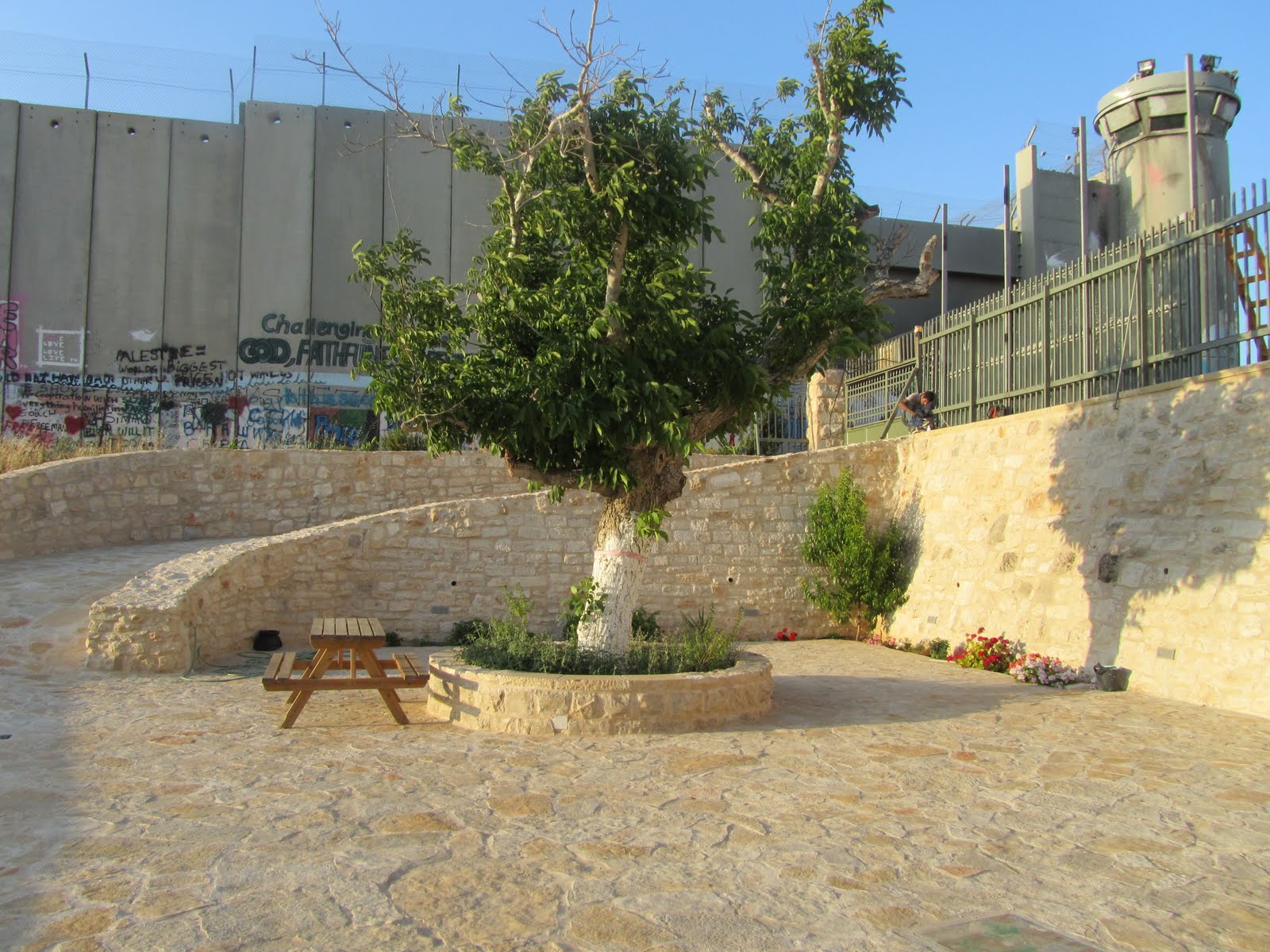
Graffiti on Israel's Separation Barrier in Bethlehem

Sunday, 26 June 2011

Palestinian Walks

Not long finished reading "Palestinian Walks" by Raja Shehadeh, a Palestinian lawyer who lives in Ramallah and who founded Al-Haq human rights organisation before becoming an author. It was very helpful in increasing my knowledge after my visit to Israel and the West Bank and written in a very readable style. It is based around 7 hikes in the countryside of Palestine that the author made between the years of 1970 and 2007. My review is already posted on Amazon so I won't repeat that here. Palestinian Walks

Endeavouring not to quote too much, and thus breach copyright, I have selected a brief section from a conversation that Raja had when he stumbled on a gun-carrying Israeli settler on one of his walks (p 193-4 in the book). Settler is a term used for Israelis who live in Jewish only communities that have been built on land which is deemed to be Palestinian under international law. Settlements are seen as one of the five main issues that Israelis and Palestinians disagree on, as both Israelis and Palestinians know how difficult it will be for a resolution that gives Palestinians full access back to their land when there are, in many cases, large townships of Israelis living on Palestinian land. There was recently a temporary cessation of building of settlements at the request of the US government, but building has resumed. Shehadeh's conversation shows that even when Arabs and Jews live in close proximity, the barriers mean they still know nothing of each other.

"I suspected you were an Arab but was not sure. Arab's don't walk."
"How do you know that? Are you acquainted with many Arabs?" 
"No. None at all."
"Then how did you come upon that conclusion?"
"Just from watching the village people nearby. I never see them taking walks or sitting by the water."
"Perhaps because they're afraid?"
"Why should they be afraid?"
"Because of you."
"Of me?"
"Yes aren't you carrying a gun?"
"I wish I wasn't. It's heavy and it's a burden. But as I said, I have to."
I couldn't help saying: "I suppose you do" in a heavily sarcastic voice though I regretted doing so almost immediately. I was inviting a fight when I had no stomach or inclination to get into one.
"What do you mean?" the settler snapped.
"To protect the land you've taken from us," I said in a matter of fact way, resigned to what was coming.
"We didn't take anyone's land. Dolev is built entirely on public land."
"Assuming it is, why should you be the only beneficiaries?"
"Because it was promised to us. All of Eretz Israel is ours."
"And where do you propose we live?"
"Eretz Israel" being the land included within the Biblical Promised Land. To understand the concept of how Israel determines "public land" within the Occupied Territories you'd have to read the book and if you're interested in such things I would certainly recommend it.

  Countryside around Nazareth
 Wilderness on the way to Jericho

 A small Jewish settlement close to Bethlehem, near the Shepherd's fields

Saturday, 25 June 2011

Bethlehem's Pressures

Having visited Bethlehem earlier in this month in my first ever visit to Israel and Palestine, I was surprised to catch on BBC iPlayer last week an interview given by the Archbishop of Canterbury on "World at One" where he mentioned the pressure that Christians were under in Bethlehem as part of general comments on the difficulties Christians face in the Middle East. His rationale was that the Christian population was reducing due to migration partly for economic reasons and also as a result of the pressure that they felt due to the movement of more Muslims into the area as they in turn escaped the pressures of other towns like Hebron. Archbishop of Canterbury on World at One 14 June 2011

Not once in the interview did the Archbishop mention the words "Israel" or "occupation". Whatever one's views of the Israel/Palestinian problem it is not possible to talk about the situation of Christians in Bethlehem or any other part of the West Bank without mentioning Israel. Hearing the interview reminded me of an article I'd read in The Guardian the week before I went to Israel on the bias in the BBC's reporting on Israel and Palestine and the strength of the pro-Israel lobby in challenging anything reported which they could see as negative about their actions in Israel or the Occupied Territories. Had the Archbishop been told he couldn't mention Israel? And why would he comply with such a comment? Dr Rowan Williams seems a highly intelligent man with a desire for justice, why would he so misrepresent the situation? Certainly Christians in Bethlehem were not pleased with his comments. Letter from Kairos Palestine. It is important to be able to speak out against Israeli state policy or unjust incidents, without being afraid of the challenge of being anti-Semitic. If for example I were to speak out against the war in Iraq and British policy there it does not make me anti-British, simply opposed to a policy.

During our 5 days in Bethlehem as a church group we had the privilege of meeting a number of Palestinian Christians of different denominations, all of whom under difficult circumstances believed in non-violent means of attaining justice and peace for Palestine. Not one of them mentioned pressure from an increased Muslim population in the town, all be it that there has been an increase. Instead they mentioned the oppression of the 9m high wall which surrounds the town and most of the West Bank, including large areas that the UN in 1948 allocated to Palestine. Only about 5% of the Bethlehem population have permits to go into Israel on the other side of the wall and the few that can go to work in Jerusalem only 6 miles away have to queue for at least 2 hours each morning to get through the security checkpoints at the one exit Palestinians are allowed to use. The wall and it's watchtowers dominate the town and as in all the West Bank divide people from their land or their customers.  As a couple of Bethlehem residents commented wryly, if Jesus were to be born these days, the wall and checkpoints would prevent Mary and Joseph from reaching Bethlehem from Nazareth. Worse still are the checkpoints within the West Bank which limit the movement of Palestinians from one town to another that are supposedly under their control as part of the Oslo Accord.


What I did learn during my 7 days in the Holy Land is far more than I can fit in a few blog posts, but despite the fact I thought I was a person with an above average grasp of world affairs I realised more than anything how little I really knew, how difficult solutions are but how unsustainable the current oppression of Palestinians is and how difficult Israeli policy makes it for everyday Israelis and Palestinians to get to know one another. Israel, however is certainly not alone in this world, in taking the natural shock and fear related to acts of violence which have been perpetuated against their people (as well as the Palestinians) and using it to breed a culture of fear and of the idea of having a superior claim to righteousness in one's cause. Sadly over the last century a far greater number of Jews have lost their lives at the hands of Europeans than of Arabs.

I suspect reflections on my trip will constitute the main part of the next few posts I make, but for now I'll end commenting on how surprised I was with the warmth of the welcome we felt from the people we met in Bethlehem, not only our guides and special guests, but people working in shops and wedding guests awaiting the exit of the bride and groom at the Church of the Nativity. I could walk alone on the streets without feeling the unease you can in some other parts of the world.

Tuesday, 21 June 2011

Big or Beautiful or Both?

Now I know that whilst preferred shape and shade can be personal, it is also always culturally linked and can vary with the era as well as the place. When I visit home all tanned from the Nicaraguan sun, people invariably comment how healthy I look - the concept supposedly coming from the idea in more recent years of a tan as an indication of enough wealth to travel overseas on vacation and perhaps the fact that you should feel more relaxed and healthy after a holiday. A hundred years or so ago the palest skin was prized as a indication of sufficient wealth to avoid manual work in the sun.

Whilst sun beds are marketed to the pale skinned, bleaching products are promoted to the darker skinned.

Size matters too and also how it's talked about. In Guyana no-one would hesitate to say "you getting fat" or "you getting fine" or that I was "putting on/throwing off size", it was just a friendly observation and sometimes I felt that I was going from "putting on" to "throwing off" size so fast it must have been ounces, not pounds they were talking about! My brain knows the British obsession with thin as the ideal form is not realistic or even always desirable, but none the less I warned several friends not to ever say to someone in the UK that they were fat or even getting there - at least not if they hoped the other person might speak to them again.

Even health charts seem to be geared towards the cultural norms. My 6'2" dad, who's been thin all his life was all of a sudden last year according to his doctor's charts deemed as getting close to "obese", whilst my weight, with definitely a higher Body Mass Index, was deemed the high end of normal, not even quite making it into "overweight" by my Nicaraguan doctor. In fact the doctor who attended me told me I shouldn't lose weight as my face would start to look gaunt and I'd look older. No diets, that's what I like!

In a Spanish-English dictionary if you look up the word "hermosa" you will see the definition "beautiful". However when "hermosa" is used in Nicaragua it generally means chubby, plump or fat. I haven't worked out whether that's because fatter is beautiful, or whether it's simply a nicety. So despite knowing other cultures I've lived in don't have the same view of size or even talking about size and that they don't have the terrible British underlying correlation that fat means ugly I was surprised to find myself abruptly irritated when a smiling work colleague told me I looked "beautiful" in my jeans after returning from a recent holiday during which I'd eaten a lot. Made me wonder how even living abroad for quite long periods we carry so much internalised beliefs from our culture, even largely illogical ones, and how potentially damaging that can be to good understanding and relations with others.

Sunday, 19 June 2011

To Blog or Not to Blog?

A question that I’ve had for a few years now but there are always three big deterrents that have held me back.


1.       Firstly it of course seems terrible arrogant that I should think I have something sufficiently interesting to say that other people want to read it. It may be possible to have the occasional engaging thought, but can I manage it consistently? There is an idea among my friends that because I live in a foreign country my life is somehow more interesting, but after the first year you stop noticing most of the differences, life is normal just a different normal.
2.       Secondly privacy seems to be a sensible thing, why would I want to put my musings in an almost uncontrollable public domain?
3.       Finally on leaving Guyana, after it being my home for more than 3 years, a Guyanese friend gave me some good advice, he told me to be careful what I told people of Guyana and my experiences there. His reasoning was sound, almost everyone I would speak to would have no knowledge of Guyana and therefore their entire opinion of that country and its people would be based on what I said to them. Since few people know where Guyana is and it rarely makes the news he was perfectly right, for good or for bad I had become an unofficial “Ambassador” for Guyana and despite the difficulties you inevitably face living in a different culture and country I knew I wanted to be a good ambassador.

I have noticed that in some popular books of travel-writing the author seems to relish pointing out the idiosyncrasies of the host community to which he or she is visiting and the longer I live abroad the more that style of writing irritates me, it seems so superior trying to gain laughs at others’ way of doing things. It is inevitable that we will all notice differences when we spend time in other cultures, but I think to live well we need to recognise that differences have their reasons and “our” way of doing things may be better in some ways and “their” culture is better at others. I am not always successful at living with and among others culturally different from me with an attitude of learning, but I hope I’m getting better.

Being an outsider, sometimes we see more clearly and sometimes what we think we see we’ve totally misinterpreted. Being an outsider should mean we learn to see our own culture a little more clearly too and that also can be uncomfortable.

So, obviously, the fact you are reading this means I have decided to take the plunge and try to blog. Hopefully I will manage to be a good ambassador, but not a false one, and in that offer a little more understanding of our common humanity as well as offering a few of the cultural frustrations and mishaps that inevitably face “the outsider.”